 Call Us MN: 24/7 confidential, bilingual crisis line (651) 772-1611
Our government is built on the promise that those we choose to represent us know what we need. Education legislation should have teachers’ input. A law about veterans’ benefits should be shaped by veterans’ voices. It makes sense that policies created to support survivors of sexual assault should center survivors’ lived realities, that their stories drive their members of Congress’s votes.
But what does that look like? As policy advocates, we serve as a two-way bridge between Washington and survivors. How do we go beyond good intentions? How do we provide trauma-informed support to survivors who want to shape policies that stop what happened to them from happening to anyone else, all while still carrying their own trauma and grief?
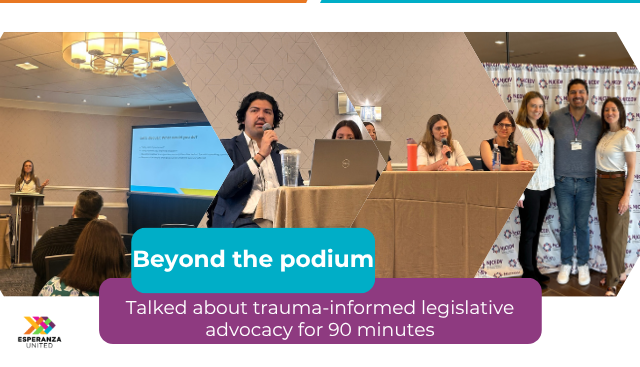
I had the honor of leading a plenary at the National Sexual Assault Conference to discuss just that.
I was nervous picking up my first conference mic, but I almost forgot to feel anxious as time went on. It was a genuine privilege and joy to share space with policy advocates, coalition leaders, and survivors who were excited to spend 90 minutes discussing survivor-centered policy advocacy in practice.
When a survivor wants to be heard, what gets in the way?
That was the question I put to the room, and the answers were honest. We learned that across state lines, political parties, and communities, survivors face the same obstacles.
Negative past experiences. Too often, survivors are invited to participate as a well-intended symbol rather than a genuine voice with power and agency. Many have tried to engage before, only to share the most painful details of their experience in a one-time, public, high-stakes setting: a hearing, a meeting, a testimony, with no debrief, no follow-up, and no ongoing relationship with the office they showed up for. When the bill didn’t move or the outcome wasn’t what they’d hoped, that was where their involvement ended: one-time, traumatic, and unresolved. When speaking up results in trauma with no reward, that experience can harden into a valid reason not to try again.
Fear of re-traumatization and loss of privacy. Revisiting painful experiences in a public, political setting carries real risk. Survivors are often pressured to disclose more than they were ready to share or are asked insensitive questions. Some choose to keep their survivorship to themselves to avoid backlash from their family or communities. Being outed as a survivor without their informed consent can do more harm than good.
Access barriers. For many survivors, getting to the table at all is the first obstacle, let alone finding a seat. Childcare, transportation, and time off work are real constraints that advocacy spaces rarely account for. For those navigating the process in a second language, or without anyone to talk them through how it works, the system can feel entirely out of reach. Not knowing who to call is often enough to stop someone before they start.
What we’re doing about it
Unfortunately, our policy team has observed these same obstacles. I got to share our thought process and results in mitigating risk and supporting survivors’ informed decisions through our initiatives over the past year.
We launched our first Congressional Week of Action in 2025 to connect Latin@ and immigrant survivors directly with their federal representatives. We made sure survivors knew from the start that they had options. They could speak generally about survivors they know, show up as a community member, or simply introduce themselves and begin building a relationship. Sometimes a staffer’s uninformed question became an opportunity to educate the office on what survivors in their district actually need. All of these are valid forms of advocacy. All of them matter.
Before any meeting, we walked survivors through what to expect: how a meeting flows, that staffers are paid by their constituents’ taxes to listen, and that anxiety is not a sign that someone isn’t ready. It’s a sign that what they’re doing matters to them. We accompanied survivors to their virtual meetings, ready to step in if a question turned insensitive or off track, and closed the week with a cafecito-style gathering to debrief and celebrate together.
That gathering was not the end. In 2026, we launched Esperanza United’s inaugural Survivors Council, four survivor consultants whose lived experiences help keep our policy team’s work genuinely survivor-centered. One participant from the 2025 Week of Action is now a council member, which is exactly the kind of ongoing relationship this work is meant to build. The council is currently being trained to lead Policy Advocacy 101 sessions themselves, bringing this work directly to their communities and ensuring that those most affected by these policies help shape how others learn to fight for them.
Carrying it forward
Hearing about the burdens survivors carry across our country was daunting. By the end of the session, that weight was eclipsed by gratitude. I stood in a room full of thoughtful, dedicated professionals building roadmaps and bridges for survivors, and I know with certainty that with advocates like these doing this work across states and communities, more survivors are shaping policy every year.
I put the mic down with a renewed sense of purpose. We all carried hope, lessons from our peers, and motivation back to our work in Washington, D.C., Minnesota, Texas, New Mexico, Colorado, Arizona, and beyond.
Mary Lu Schmid Policy Coordinator, Esperanza United