 Call Us MN: 24/7 confidential, bilingual crisis line (651) 772-1611

The email was only a few lines long: “My daughter’s not OK. I think that she needs you.”
It landed in Nallely Castro Montoya’s inbox more than a year after she had last heard from the young woman, who first joined Esperanza United in middle school. What Nallely did next, and what happened months later, became the heart of a morning conversation about what it really takes to prevent violence before it starts.
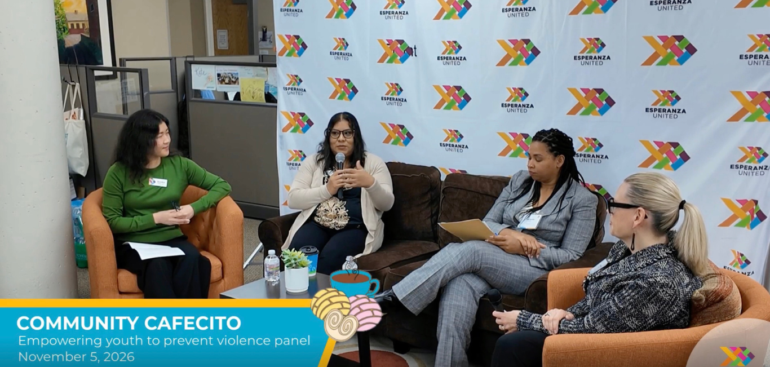
On November 5, community members, partners and staff gathered over coffee and food for our second Community Cafecito, a space created to deepen relationships, connection and community. The topic could not feel more urgent. In Tubman’s experience, about 75% of people experiencing violence are under the age of 25. And yet prevention remains one of the hardest things to fund, because as a society we tend to invest in the crisis instead of what comes before it.
Guided by our Chief Strategy and Programs Officer, Anika Gifford, the conversation brought together three panelists she lovingly called “three unicorns”:
- Jennifer Polzin, President and CEO of Tubman, which is celebrating its 50th anniversary this year, and one of the most respected voices in the movement to end gender-based violence
- Nallely Castro Montoya, our Assistant Director of Prevention and Social Change, who first came to Esperanza United as a youth participant
- Marquita Butler, Associate Director of the Ann Bancroft Foundation, who has spent more than a decade making sure girls have spaces that help them grow strong, smart and bold
Young people already know what they need
Prevention is often imagined as adults handing information down to young people. The panelists described the opposite. The strongest programs are built by, with and for young people, and they help them move from simply surviving to thriving. That is why Tubman’s classroom work starts with what a healthy relationship looks like, long before anyone talks about abuse. Most of us were never taught that directly.
Marquita knows the pull to tell young people how to live. She is a youth professional and a mom of a teenager and a toddler. “Oftentimes I have to sit back and listen to them and what they want and need,” she said. “They know what they need to thrive. And sometimes, as adults, we don’t listen.”
Listening, in other words, is not the passive part of prevention. It is where prevention begins.
Nurturing the roots
At the Ann Bancroft Foundation, prevention starts with a different question. Instead of asking what young people should avoid, the team asks what they want young people to experience and how they want them to feel. Above all, seen.
Sometimes that looks like a $1,000 grant for a soccer season or dance classes. When money gets tight, extracurriculars are often the first thing families cut, even though they are often what keeps a young person away from a harmful situation. “We look at it as nurturing the roots versus the fruit that the tree produces,” Marquita said.
The same idea shapes Esperanza United’s approach. Nayeli’s team once worked with youth, men and women in separate groups, then sent them home to families who weren’t having the same conversations. When one whole family went through the trainings together and began talking to each other differently, the team shifted to a whole-family approach. Roots grow stronger when the whole family is part of the soil.
Leadership doesn’t always stand at the front
When young people are trusted, they step up for each other. Jennifer has seen youth “stand a little taller when they’re heard and seen and listened to,” especially when they get to shape the message for their peers, in their own language.
Nallely sees the ripple effect firsthand. Recently, a new participant was connected to our team because friends who had been through our trainings recognized the signs and asked for help on their behalf. “Leadership isn’t just the person who’s in front of the camera or in front of a protest,” Nayeli said. “Behind the scenes is also leadership, and it’s equally important.” One training can reach a whole circle of friends.
Trust opens the door
Which brings us back to that email.
Nallely didn’t push. She sent a simple note to check in and ask how the young woman’s first year of college was going. The reply was honest: she wasn’t ready to talk, but she would reach out when she was. “Sounds great,” Nallely wrote back. “I will be waiting for you.”
A few months later, she did reach out. Today, she is trained to facilitate a national financial literacy curriculum, helping other young people build the tools she once needed herself.
“It’s putting that trust in them and not obligating or forcing them,” Nallely said. “I think that’s how we can begin those healthy relationships.”
What we carry forward
Three lessons stayed with the room: listen first, invest early and trust young people to lead. None of it happens alone. As Nallely reminded everyone, this work is hard and shouldn’t be done in isolation, which is why partnerships matter so much. Esperanza United recently led a healthy relationships workshop at the Ann Bancroft Foundation’s Girlhood Summit, and conversations like this Cafecito are how those connections grow.
As Anika put it in closing, working alongside young people asks adults to set aside ego, stay humble and open, and keep following their lead.
The roots that hold
A father’s worried email. A young woman who needed time. An adult who said, “I will be waiting for you.” That is what nurturing the roots looks like, and it is why prevention matters long before a crisis ever arrives.
Thank you to Jennifer, Nallely and Marquita for sharing your wisdom, and to everyone who joined us around the table. Watch the full panel and learn more about our youth programs. This Give to the Max Day, help us keep these roots growing.