 Call Us MN: 24/7 confidential, bilingual crisis line (651) 772-1611
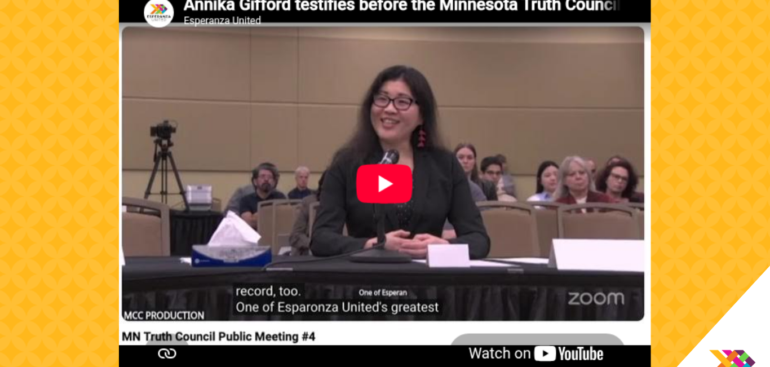
On Tuesday, September 29, the Minnesota Truth Council held the fourth and final of its public meetings at the Mayo Civic Center in Rochester, centered on the theme “A Window into Policies and Systems Contributing to Harm.” Annika Gifford, our Chief Strategy and Programs Officer, testified on behalf of Esperanza United and the survivors we walk alongside every day.
The council is building a public record of what Minnesotans lived through during Operation Metro Surge last winter. Ahead of the meeting, our team met with Robin Phillips, lead advisor to the council, to share the experiences of our participants and staff here in the Twin Cities, and how communities are being impacted nationally. Annika’s testimony draws on our Impact Report on Operation Metro Surge and on the voices of so many who could not be in the room.
You can watch the full testimony on YouTube. Here are some of the moments that stayed with us.
Gender-based violence is not rare
Annika opened by grounding the council in the reality our communities live with.
“For nearly 45 years, we’ve had the privilege of working alongside thousands of survivors of domestic violence, sexual assault, dating violence, stalking, and trafficking here in the Twin Cities. Unfortunately, gender-based violence is not rare.”
She shared that according to Violence Free Minnesota, the state’s domestic violence coalition, at least 24 people were killed because of intimate partner abuse in Minnesota in 2024. For immigrant survivors, she explained, immigration status is often used as one more tool of abuse: “Call the police, and you will be deported. Lose your children. Lose your health insurance. Lose your financial security.”
“In our work, one lesson holds above all others: safety depends on trust,” Annika said. “A survivor’s path out of violence runs through systems: a 911 call, a hotline, a courtroom, a clinic. When real or perceived fear closes off those systems, survivors are not safer. Families are not safer. Communities are not safer.”
That is what our team watched happen last winter. “When ICE and Border Patrol agents arrived, survivors stopped leaving their homes. One woman we serve did not take out her trash for weeks out of fear of ICE.”
The fear started building even before the surge reached Minnesota. In November 2025, calls to our bilingual crisis line dropped by 25 percent. “There were not fewer victims,” Annika said. “There was more fear that reaching out to any system could lead to immigration enforcement.”
Survivors avoided hospitals, courts, and places of worship, the very places where help is supposed to be. Parents kept children home from school, even though for many of those children, school meals were the most reliable food they had. And although the Minneapolis and Saint Paul police departments did not cooperate with ICE, many survivors could not tell a local officer from a federal agent, so they did not call 911, even during the worst of assaults.
Annika described how the impact went far beyond fear. One survivor who supported her family by driving for a ride-hailing service stopped driving to avoid being targeted, and her income disappeared. Families had to pay immigration bonds for detained loved ones while their income was shrinking.
For some families, the damage is permanent. One family we serve, with an active asylum case, was told by their attorney that the case was unlikely to succeed. Facing legal fees and lost hours at work, they chose to self-deport. “They asked only to finish the school year first because both parents worked in schools.”
“One of Esperanza United’s greatest strengths is our staff, who live, work, and are part of the communities we serve,” Annika shared. “Our amazing team continued to provide high-quality services and support without interruption, while also being afraid and targeted.”
Our staff coordinated weekly food deliveries to families sheltering in place and, when it was safe, checked in on participants so no one felt alone. We stretched emergency financial assistance far beyond normal levels so survivors and their families would not have to worry about losing their homes, going hungry, or having their utilities shut off.
What would help families heal
While the visible presence of federal agents in the Twin Cities has shrunk, Annika reminded the council that the effects are still very real. Survivors now face new documentation requirements to get jobs or open a bank account, and “an expired tab or a lapsed insurance card can feel like it could cost a family everything.”
She shared six measures that would help stabilize families and rebuild trust:
- Identification and accountability: Federal officers working in our communities should be clearly identifiable, unmasked, and wearing body cameras
- Protecting sensitive locations: Survivors must be able to go to a hospital, a courthouse, a school, a place of worship, or a domestic violence shelter without fear
- Rebuilding trust with local law enforcement: Public education in the languages our communities speak, making clear what police will and will not do with immigration authorities
- Housing and economic stability: Eviction protections and expanded rental and utility assistance
- Support for kinship caregivers: Grandparents, aunts, uncles, and family friends now raising children whose parents were detained or deported
- Sustained investment: Ongoing, not one-time, funding for community-based, culturally specific survivor services
Where we begin, and where we end
Annika closed where she began, with trust. “For a survivor, safety is not the absence of violence. It is being able to reach out and know that someone will answer without putting them or their family at risk.”
Last winter, many Minnesotans lost that. But as Annika reminded the council, Minnesotans also showed the world what living our values, courage, and care looks like. Our work continues, alongside our communities, to ensure safety and thriving for all survivors of gender-based violence.
We are deeply grateful to Annika for carrying so many voices into this record, and to everyone who shared their experiences to inform our Impact Report. Watch the full testimony.